
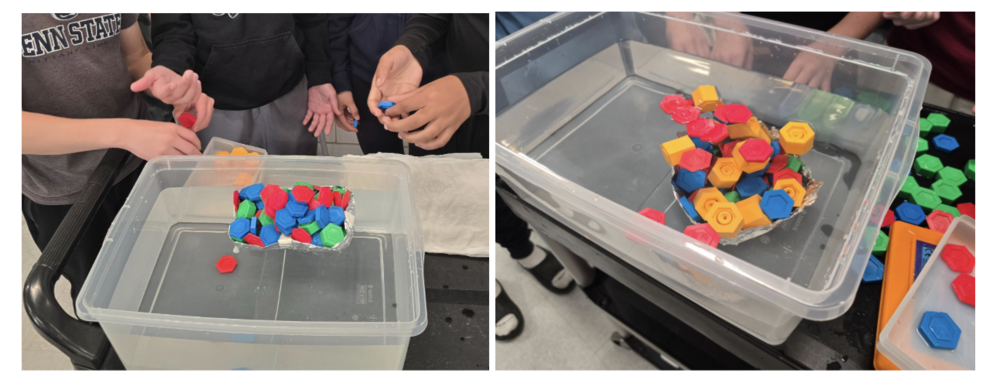
Log College Middle School 7th-grade student scientists recently took on an exciting, hands-on engineering challenge to bring the concepts of density, gravity, and buoyancy to life! Tasked with designing a vessel capable of staying afloat, student teams put their understanding of physical science into action using everyday materials like aluminum foil, paper clips, tape, paper, clay, rubber bands, and straws. Working collaboratively, teams brainstormed optimal hull shapes and analyzed the density of each material. Students creatively transformed simple supplies into floating watercraft by designing their vessels to trap air, maximize buoyancy, and remain less dense than water.
The energy was high during class testing as students put their designs to the ultimate weight-bearing test. The results were impressive: while many boats supported an average of 300-400 grams, the top-performing design held up to an astonishing 1,000 grams! Through testing, students quickly discovered the critical relationship between vessel size, shape, surface area, and capacity. They discovered that tall, secure walls were critical for keeping water out. They also learned the importance of using clay strategically, applying it as a waterproof sealant or base expander rather than heavy weight that drags the boat down.
To conclude the investigation, students analyzed their performance data and reflected on the lessons learned. Each team created a showcase poster featuring a newly redesigned boat model, illustrating the specific modifications they would make to improve their vessel's performance in future trials. This project not only deepened our students' understanding of core physics concepts, but also highlighted the true spirit of the engineering design process: collaborating, testing, and continuously innovating!